• Login
  • Work With Us
  • Contact
  • Login
  • Work With Us
  • Contact
SUBSCRIBE
Facebook Instagram
  • News
  • Local
    • Arts & Culture
    • Business
    • Community
    • Food
    • Opinion
    • Sports
    • Travel
  • Travel
  • Obituaries
  • E-Editions
  • Calendar
  • News
  • Local
    • Arts & Culture
    • Business
    • Community
    • Food
    • Opinion
    • Sports
    • Travel
  • Travel
  • Obituaries
  • E-Editions
  • Calendar
  • News
  • Local
    • Arts & Culture
    • Business
    • Community
    • Food
    • Opinion
    • Sports
    • Travel
  • Travel
  • Obituaries
  • E-Editions
  • Calendar
Search

Burgess shale fossil bed shows the geography of Field

Colleen Palumbo by Colleen Palumbo
February 19, 2013
in Life

Long before Charles Doolittle Walcott discovered the now famous Burgess Shale Fossil Beds, workers on the CPR at Field had found want was known then as “stone bugs”.

The site had also been looked at by RG. McConnell of the Geological Survey of Canada, in 1886, the same year that Yoho National Park was established.

By word of mouth, the story of the stone bugs became known to Charles Walcott, who came to have a look in July 1907.

Walcott, without any formal scientific training, became interested in collecting fossils in his early teen years. Walcott was fortunate to have met and been befriended by retired museum curator Colonel Jewell, who really helped open Walcott’s mind to what the fossils he was collecting meant.

Working as a farm labourer in Trenton Falls, New York, allowed Walcott to continue with his passion for collecting.

At the age of 20, Walcott went to work on a farm for William Rust, who also had a passion for collecting.

It was Rust who showed Walcott where to look and what to do with the fossils once they were found.

They were very good at what they did, and soon they were selling their fossils to collectors all over. In September 1873, Walcott had his only real involvement with college when he went to the Museum of Comparative Zoology at Harvard to unpack the fossils that he had sold to Professor Agassiz.

Incidentally, he made a huge amount of money from that sale and another sale made to Agassiz’s son in 1879.

In 1876, Walcott became assistant to James Hall, the state paleontologist of New York.

This gave Walcott the knowledge he would need to carry on with his career, and upon leaving Hall’s employ, Walcott took a job as a temporary geological assistant for the United States Geological Survey for the sum of $50.00 a month.

Over the next 15 years, Charles Walcott worked hard to place himself as one of the top paleontologists in the world and in 1894, he became the third director of the Geological Survey.

His writing became world-renowned, and still, he never stopped.

In 1907, he became the fourth secretary of the Smithsonian Institution and went to work in the field, mainly in Alberta and British Columbia. During his collection years(1910-1917) at the Burgess Shale site, Walcott and his family collected and sent to the Smithsonian Institute more than 65,000 fossil specimens.

In 1930, another scientist named Percy Raymond came from Harvard University to open up another smaller quarry just above the Walcott Quarry. He collected fossils from both Quarries.

The Quarries (Walcott and Raymond) were reopened in 1966 by the Geological Survey of Canada and again in 1975 by the Royal Ontario Museum, with collecting taking place over a period of at least 17 years.

In 1981, the Burgess Shale site was designated as a UNESCO World Heritage Site 1981 and visitors to the quarry are no longer allowed to remove stone bugs.

According to the Royal Tyrell Museum, there are over 200,000 fossils collected from the Burgess Shale site. These collections are held in museums and private collections all over the world.

From the earliest days of the discovery of the Burgess Shale beds, people went to the site and brought home souvenirs. Many of the young people in Field and Golden went to the site specifically to bring the fossils out to sell to people who got off the train. Hundreds and perhaps thousands of fossils were sold to visitors from all over.

And so it was from one of these private collections that the Golden Museum was given a reasonably good fossil, which is on display at the Golden Museum.

When you visit the museum to look at the stone bugs, be sure to have a look at the photographs of Golden scenes and people that are for sale on the front counter.

Colleen Palumbo

Colleen Palumbo

Related Posts

August celebrates two “supermoons.” The first – the Sturgeon Moon – appeared over the mountains south of Princeton August 1 and was captured by well-known local shutterbug John Moody. According to the Farmer’s Almanac the Sturgeon Moon is so named to honour the giant Sturgeon fish, which can be traced back 132 million years and is sometimes called ‘the fossil fish.’ On August 30 stargazers will be treated to the second supermoon, the Blue Moon.
Life

Rare blue supermoon brightens the night sky this week in the closest full moon of the year

Stargazers are in for a double treat this week: a rare blue supermoon with Saturn peeking from behind.

August 29, 2023
Megan Twaits and Jeremy Marotte at Refuge Farm and Foraged Goods in Revelstoke, B.C. (Photo by Josh Piercey/Revelstoke Review)
Home2

How a Revelstoke couple forages tea for their farming business

Jeremy Marotte and Megan Twaits swapped the nine-to-five for a forest-to-table lifestyle in 2019

August 11, 2023
Next Post

RCMP Report: Dine and dasher caught

Popular Posts

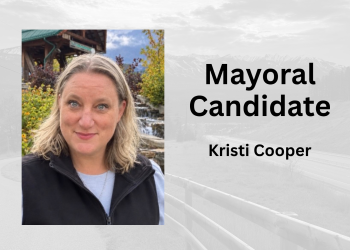
Updated: Meet Kristi Cooper, candidate for Mayor

October 7, 2026

Updated: Meet Wes Routley, candidate for Mayor

Turning Back the Pages: Golden came together to send cigarettes to soldiers

Updated: Meet Dustin Shanahan, candidate for Council

  • A little bit of everything in an October day in the mountains 🍂🏔️
  • Power
  • Thank you to everyone who came out to celebrate, share stories, enjoy some good food and music, and mark this special piece of Golden’s history with us 💛
  • Flashback Friday 📰 Fall 2001!

Take a look back at these archival pages from the Golden Star and Golden News about the Kicking Horse Pedestrian Bridge.

Built in 2001 by volunteer timber framers and locals, this iconic bridge is Canada’s longest freestanding timber-frame structure and a true symbol of community connection.

Now, 25 years later, it’s time to celebrate!

Join us at Spirit Square tomorrow evening (Saturday, Sept 26) to celebrate the 25th anniversary. See you there, Golden!
  • A pretty great way to celebrate 25 years! 🎬🍿

The Princess Bride, popcorn, hot chocolate and a beautiful evening spent outside together. 

Thanks to the Golden & District Community for hosting such a fun night!
  • It’s officially Golden season 🍂💛
  • News
  • Local
    • Arts & Culture
    • Business
    • Community
    • Food
    • Opinion
    • Sports
    • Travel
  • Travel
  • Obituaries
  • E-Editions
  • Calendar
  • News
  • Local
    • Arts & Culture
    • Business
    • Community
    • Food
    • Opinion
    • Sports
    • Travel
  • Travel
  • Obituaries
  • E-Editions
  • Calendar
SUBSCRIBE
  • Work With Us
  • Contact Us
  • Work With Us
  • Contact Us
Facebook Instagram

COPYRIGHT 2026 GOLDEN STAR

No Result
View All Result
  • Home
  • Landing Page
  • Support Forum
  • Buy JNews
  • Contact Us

© 2022 JNews - Premium WordPress news & magazine theme by Jegtheme.